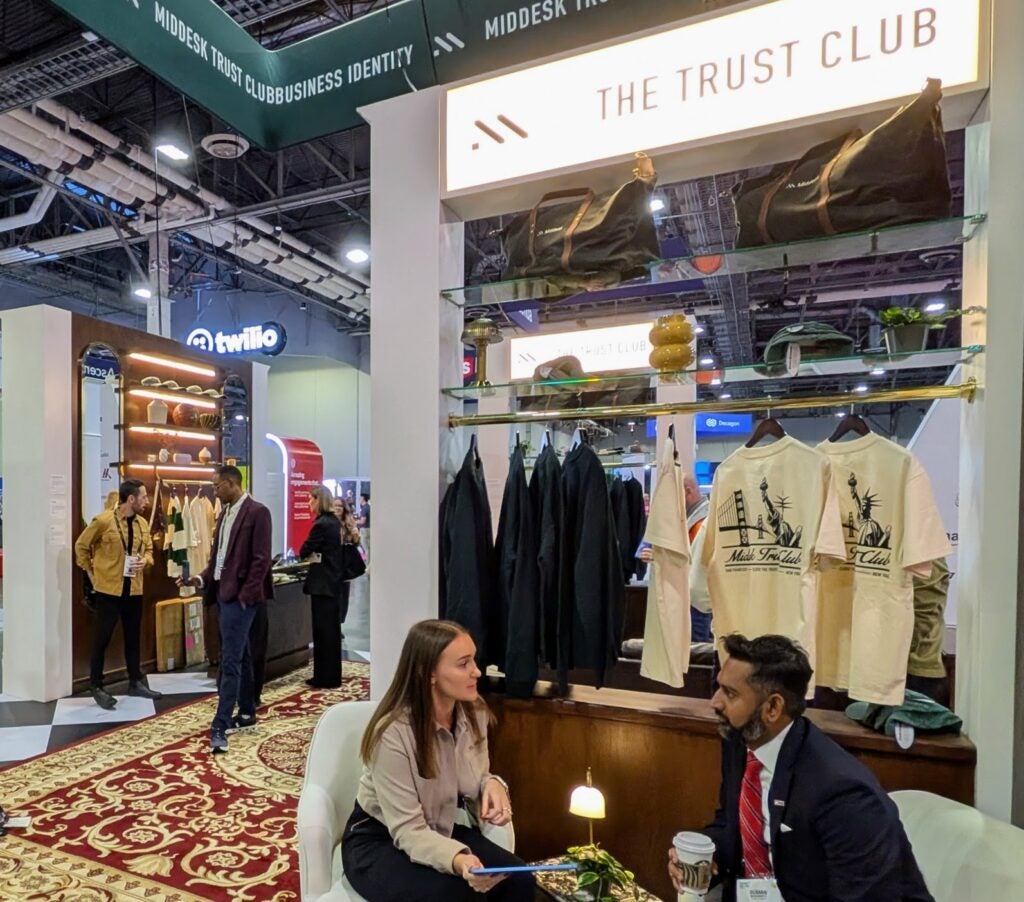
Middesk’s exclusive merch at Money20/20 offered a glimpse at the future of business. (Photo: Anna Huddleston/Event Marketer)
When Middesk set out to build trust with Money20/20 attendees, it transformed its booth into “The Trust Club” filled with custom-designed merchandise created specifically for the trade show experience. From heavyweight crewnecks to limited-edition duffles, the brand designed exclusive items to drive engagement at different levels, all leading back to the overarching message.
“Trust is timeless, so we wanted to tap into that narrative, but also our brand is modern and nimble, and we wanted the Club to reflect that,” says Kate Young, event marketing manager at Middesk. And the merch? “We wanted it to feel like the first drop from your favorite lifestyle brand, but made for the people shaping the future of business identity.”
Branded merchandise has always held a place in trade show marketing, but it’s quickly evolving from a tactical giveaway into a strategic communication channel key to every campaign aspect, from engagement to follow-up and measurement. It’s the keepsake long game.
Some 47 percent of marketers consider branded merchandise a core marketing channel, while 82 percent of recipients feel more positive about a brand after receiving promotional products, and 87 percent keep and use branded merchandise regularly, according to recent PPAI research. “As organizations look for marketing channels that deliver both performance and sustainability, branded merchandise offers a compelling combination of audience engagement, brand recall and environmental efficiency,” says Drew Holmgreen, PPAI president and ceo.
“Branded merchandise can align with a larger brand narrative,” says Cayce Myers, Ph.D., LL.M, J.D., APR, professor of public relations and director of graduate studies, School of Communications, Virginia Tech. “When it is intentional, relevant and value-added, it can help create identity, community and meaningful audience connections.”
Just about anything can be branded, and with AI, design ideas come fast and furious. This is how we’re seeing all this playing out on the ground.
Start with Strategy
“The biggest shift is that exhibitors are starting to treat branded merchandise less like a giveaway and more like part of the overall event strategy,” says Jack Kassab, vp at Ideal Promotions. “Now the stronger brands are thinking through the full experience: what gets someone to stop, what creates a conversation, what feels useful enough to keep, and what helps the sales team follow up after the show.”
As far as product choices, Kassab is seeing an increased interest in retail-forward merchandise, curated kits, and items that feel aligned with the brand rather than generic promo products.
Think: Multiple Tiers
A tiered approach is becoming an industry standard. Kassab is noticing brands developing gifting strategies based on the value of the relationship, from general booth traffic to qualified customers and VIP prospects and clients.
For Middesk, Young and her team created a menu of options: small actions for small swag with steps up to a sales meeting, client quotes about trust, and super high-quality items for VIPs who committed to a case study or event speaking engagement with the brand.
According to Young: “This gave The Trust Club a real feeling of being a retail environment to ‘go shopping’ and simultaneously the opportunity for our team to guide guests through the experience and encouraging ‘leveling up’ to the next tier if they were a good fit.”
Make Familiar Unique
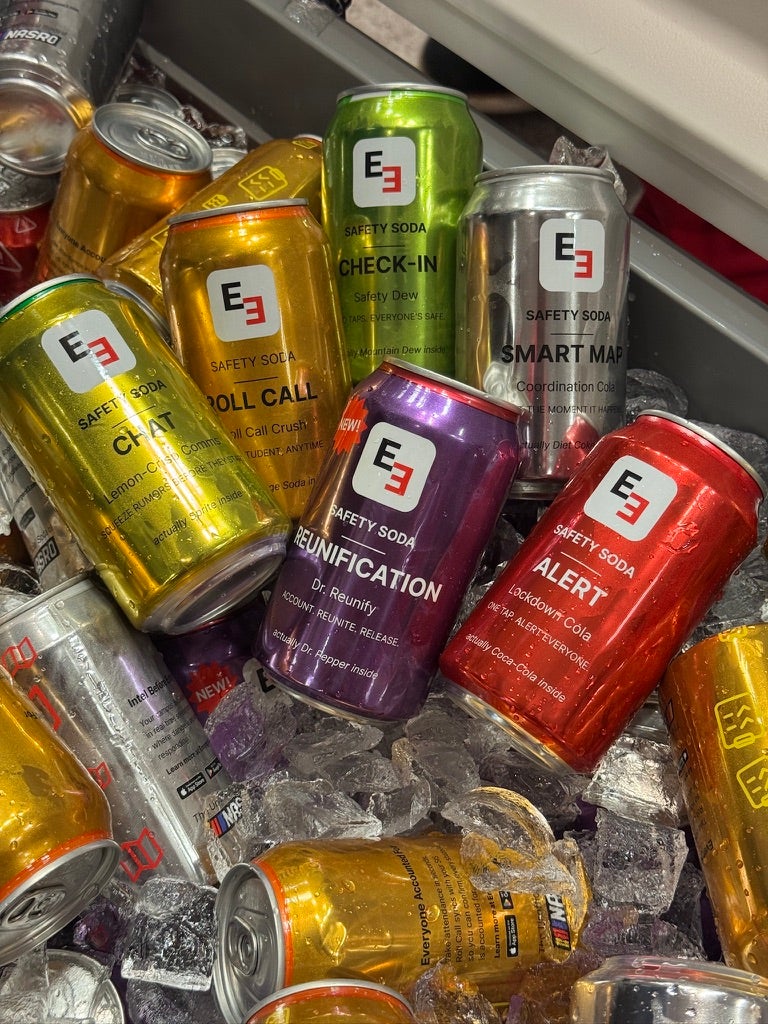
Emergent3 created custom “Safety Sodas” to break the ice with attendees at NASRO 2026.
When it comes to item selection, offering a fresh take on classic items in ways that fit the strategy is a viable approach.
“I’ve learned not to underestimate practical products,” says Dave Sarro, ceo and founder of Promo Direct. “If something earns a permanent place on a desk or in a backpack, it’s doing exactly what it was meant to do. A quality notebook, a well-designed tumbler, or a reliable tote bag can outperform something far more expensive because they become part of someone’s routine.”
Sarro says it’s not about recreating the past but about familiarity. “Products that remind people of simpler routines or everyday moments seem to resonate because they feel comfortable and authentic.”
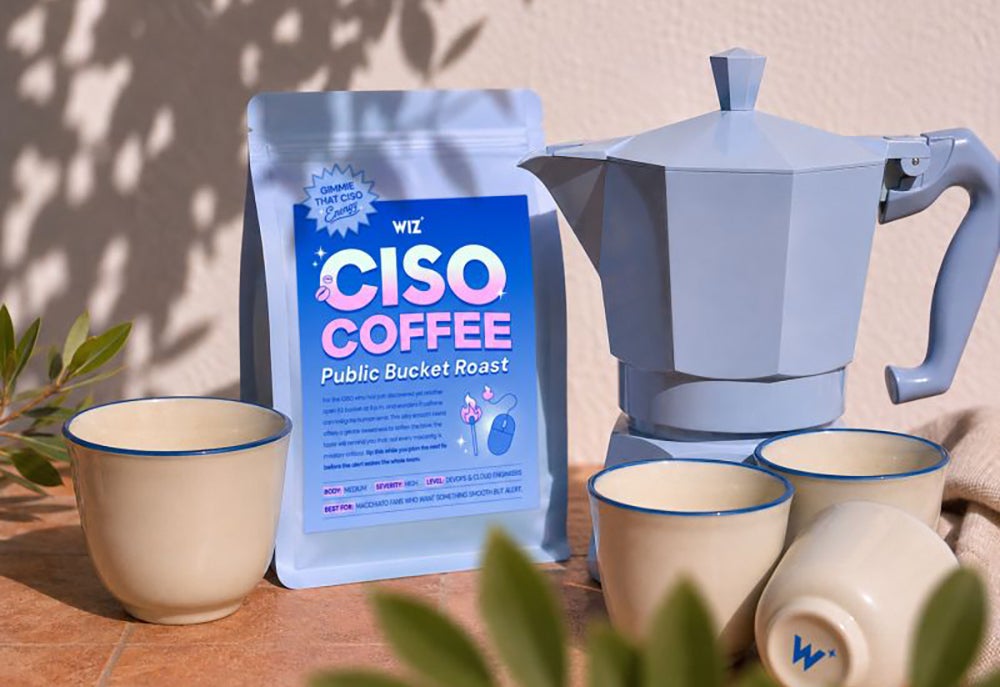
Then how about a sleep mask and comfy socks? Wiz invited cybersecurity experts to the “Wizzz Sleep Bar” where attendees could find special prizes and get the swag that helped them sleep better and wake up with a CISO coffee kit complete with Critical Roast and Wizz Blend flavors (see featured image).
What’s more familiar than a can of Coke? At the recent NASRO 2026, the national school resource officer conference, public safety app Emergent3 caught attendees’ attention with red crew pit jumpsuits and broke the ice with custom Safety Sodas—Lockdown Cola for Alert, Coordination Cola for Smart Maps, Dr. Reunify for Reunification—referencing product features. More than 500 sodas were handed out, with more than 40 meetings booked.
Collectible Counts
From large tech conferences to construction and equipment trade shows, exclusive collectible items get the same crazy love as at festivals and other types of activations. CrowdStrike, for example, launched its adversary action figures at RSAC 2024 and has been adding two new adversaries each year. Among the most coveted collectibles at Hitachi events are die-cast models of machines. Plushies, pins, and nail polish colors—yes, we’re looking at you, Sherwin-Williams—continue to build engagement and connection year after year.
Build Your Own with AI
From hat and charm bars to heat-press stations, personalization-rooted activations continue to win, but AI is making the offerings infinite. At Shoptalk 2026, for example, Optimizely brought its personalization software capabilities to life with unique scents, created right there in the booth by EveryHuman algorithmic perfumery. After being qualified by a booth staffer, attendees could scan a QR code, chat with an AI bot about their favorite scents and perfume brands, and watch their personalized perfume mixed in front of their eyes.
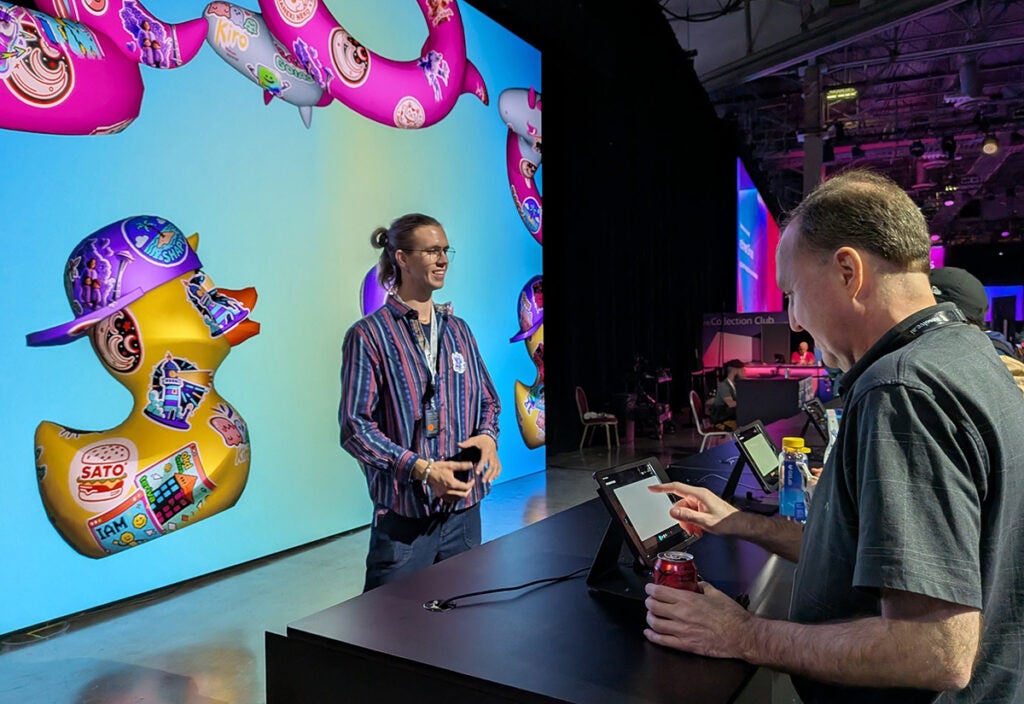
At AWS re:Invent, sketches and doodles came to life with the help of Amazon’s services Bedrock and SageMaker as custom stickers, a hit in the tech world and beyond. All that was required was drawing with a stylus and a little imagination, and GenAI did the rest.
(Photo: Anna Huddleston/Event Marketer)
Follow up and Measure
Integrating giveaways in trade show activations provides new ways for personalized and effective follow-up as well as for measuring against the brand’s KPIs. For Middesk, transparent reporting was key.
“Our team was extensively trained on how to scan leads and, through pre-set questions, quickly classify each visitor at the booth by their activities and required follow-up,” Young says. “We can see and report on those activities, the most important of which were those visitors who had taken a full meeting at the booth and required follow-up.”
The company pre-booked 160 meetings with name accounts, which completed at about 85 percent as well as added meetings from foot traffic. Young says the company generated ten times the amount spent on the activation in new pipeline, and another 26 times in influenced pipeline. “The model of gamifying swag turned out to be a great bet.”
A lower-priority goal was to grow the social media following, but a steep increase in LinkedIn followers became an unexpected success.
“By offering high-quality items—in this case, pins and luggage tags—we saw a huge leap in followers from folks genuinely interested in knowing our brand and following along with our updates,” Young says. “It surprised us how well that worked as a great supplement to the marketing team goals outside of just generating pipeline. It’s become a staple at every show.”