Sonia Andresson-Nolasco

Beyond Green Screen

Augmented reality proves itself quite the data-collection trigger

Sonia Andresson-Nolasco | From the August 2012 Issue

A GOLDEN CHOICE

As Augmented Reality becomes increasingly popular, more companies are sprouting up to provide the latest and greatest technology. GoldRun was the choice for the Courvoisier team. Let’s take a look at the details:

How it works
Using the GoldRun virtual camera app, a branded white label extension of the platform, or GoldRun’s AR camera features within an existing app, users simply select a virtual photo booth that appeals to them—whether in fashion, sports or entertainment—snap photos alongside their favorite visuals and then share their images to earn rewards from that brand.

Cost
GoldRun’s fees are based on the duration of the campaign and the coverage area—whether spanning the entire globe or taking place at specific retailers or landmarks. Clients can run campaigns for as little as $3,000 a month or integrate the technology into their existing app for basically the same cost.

Lead time
It’s as short as one week from contract to launch when using the GoldRun app. For white labels and API integration, lead time is determined with each individual client based on their specific needs, with general timelines running four to six weeks.

In life, change is constant. In event marketing, the same. And though the industry certainly continues to evolve, one quest never slows: the data chase.

Marketers across the industry need data from event attendees in order to prove performance, generate leads, push digital communication and ignore post-experience communication. And they’re upgrading age-old tactics to goose their chances of getting it.

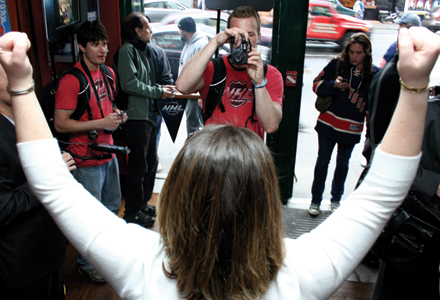
Green-screen photo activations, for example, have for years been one of the most successful triggers to get folks to give up their info in exchange for a “cool” photo. That still happens, but today’s event marketers are taking it up notch by offering more authentic photos through innovative technology, including Augmented Reality photo activations. AR overlays the virtual world on top of a real-world environment through a mobile phone or a tablet. The real-world factor is one of the reasons this technology is so appealing. And, it’s partly what made NHL Network’s Raise the Cup activation in June such a hit. Fans weren’t posing with the Stanley Cup in front of a mock green-screen backdrop. They were in sports bars with their friends.

For Courvoisier’s launch of C by Courvoisier, AR offered realism and a way to interact with a younger demographic that prefers to communicate via mobile devices. The Courvoisier team snapped consumers’ pictures using an AR app that added fun elements to the photo such as branded hats or an image of NBA star Shaquille O’Neal who partnered with the brand for the campaign. The app functioned like a green screen but without all the gear and kicked up the experience by making a virtual version of the brand’s bottle appear on consumers’ tables (Technology: GoldRun, New York City).

“The app was not only engaging and fun, but it offered a personalized, custom brand experience with the ability to share via social networks,” says Kim Washington, senior director-cognac at Beam Global, which owns Courvoisier. With green screen, a brand ambassador typically takes the consumer’s picture. But with this app the consumer has more control of the experience, which makes it much more personal. “The pass along and take-home factor is the most valuable component from a marketing perspective because it allows consumers to spread the viral message on C By Courvoisier in a very organic and authentic way,” she says. Wilton, CT-based Inspira Marketing, which handled the Courvoisier activation, has typically seen green-screen photo capture at a 20 to 25 percent share rate, but the share feature for the C by Courvoisier AR app was close to 40 percent.

NHL Network’s Raise the Cup also had high retrieval rates, says handling agency Cenergy, East Aurora, NY, which has seen a 15 to 20 percent higher retrieval rate with AR than with green screen—plus, an increase in viral sharing. “For every photo we took, fans were on average sharing that with 100 of their Facebook fans,” says John Cimperman, principal at Cenergy. “AR is a good trigger for data collection because people will work a little harder to go and get their image.” (Technology: Step Logic, Marietta, GA). 

These cutting-edge photo activations also offer logistical advantages. Without all the gear that a green-screen setup entails, street teams are more nimble and can hit more places in a lot less time. The catch? Consumers need to see what their picture will look like. For the NHL program, Cenergy equipped its brand ambassadors with monitors above their heads that ran images of consumers posing with the trophy.
Inspira used iPads to show consumers the photos and also tapped into the mounted screens at the bars, clubs and restaurants where they held the events. That strategy allowed consumers to see what the photos would look like and encouraged them to participate to have their photo show up on the big screen.

The cost wasn’t all that much more than green screen, says Kim Lawton, vp-client services at Inspira, referring to Courvoisier’s program. “The cost was at parity with green screen,” she says, citing other benefits of this type of activation, such as the ability to manipulate things. “It’s just like doing an update on your iPhone. You could instantly get new images and make changes. And because the teams all have iPads already, there wasn’t an added cost. There’s no setup required and it doesn’t take up any space, so when you go into clubs, there’s an easier sell-in factor as well.”

The cost also depends on how elaborate a brand needs a program to be. Cimperman says an AR program can end up costing 20 to 30 percent more than a green-screen activation. “The bigger part of the investment is building that backend site where fans can go to retrieve their photos, learn more information about the brand and provide their data so the brand can start to build a permission-based database.” That is generally the case with green-screen activations, too. Ultimately, it depends on the brand. But Cimperman advises, “If a brand is looking to be positioned as state-of-the art, AR is the way to go.” EM


+ EM Industry Search

Locate the Industry's Leading Partners

EM's online directories offer direct access to the event industry's most trusted vendors, suppliers, venues and more.

Browse all companies | Add/Modify Your Company

Browse all event services | Add/Modify Your Company


+ Event Marketer Gallery

EM @ Macworld: We're walking amongst the Appleheads and fanboys so you don't have to

We're walking amongst the Appleheads and fanboys so you don't have to. Watch this space for updates.

Watch it now »

THE ACER 'JOURNEY'

A LIVE SHOW, DATA-COLLECT AND TWO LEVELS OF PRODUCT DEMOS

Watch it now »

Austin Rocks SXSW 2012

You would have gone if you could have gotten a hotel room—so EM takes you there, baby

Watch it now »

Then and Now

This month's flashback: Holograms

Watch it now »

BMW Floating Showroom

The Germans bring the coolest exhibit the Olympic Park visitors almost missed.

The Coke Beatbox

The fan fave at this year’s Olympics, and we give you a look

Acer’s ‘Journey’ in Olympic Park

Two floors of demos, data-collect and Acer Man

Cisco House

The first time Olympic sponsor blows it out of the Park--literally

Connect with Event Marketer