Sonia Andresson-Nolasco | From the April 2012 Issue
How was Intel’s new b-to-c approach received? Events program manager Marc Wallis shares the program’s survey results
FULFILLING EXPECTATIONS: With average values between 4.0 and 3.9 (on a scale of 1 to 5), Intel succeeded in fulfilling the main visitor expectations, while for visitors with specific interests in certain products fulfillment was a bit lower at 3.6. “Though 3.6 is not incredibly low we do know many folks are looking for product and technical detail,” Wallis says. “We included some in the digital demos, and of course, the smartphone and tablet product displays. But without actual products or technologies on display, some visitors likely didn’t get all the information that they were seeking.”
BOOTH EXPERIENCES: More than three-quarters of booth visitors (76 percent) interacted with at least one of the four main booth experiences. Over half of visitors (55 percent) had a closer look at the digital demos. The demos and experiences are regarded as “exciting” by two-thirds of visitors (average value: 3.8). Intel conducted a separate ad hoc intercept survey of visitors as they walked away from participating in the experiences. The responses provide a general sense of the visitor takeaway:
Mobile Remix: 4.4 satisfaction rating. Shows Intel is innovative, open and modern.
Glass Wall Showcase: 3.8 satisfaction rating. Message comes across that Intel is “in mobile” and does more than just chips and processors.
What’s In Your Pocket?/Media Wall: 3.9 satisfaction rating. Shows Intel is “in mobile” and that Intel is interested in customers’ opinions.
Mapping the Future: 3.2 satisfaction rating. Fifty percent didn’t understand how it is connected to Intel.
THE CONVERSATIONS: Intel saw a 10 percent boost in the conversation rate from past Mobile World Congresses. However, the share of visitors who didn’t hold a conversation because they weren’t approached or considered the waiting time too long (13 percent overall), shows that the conversation potential was not fully exhausted. The booth staff’s performance was excellent. A high share of conversations were initiated by the staff (79 percent); and visitors perceived them as extremely friendly (4.7) and competent (4.5). “This is significant,” Wallis says. “We had wanted our staffers to perform differently, much like the Apple-store experience. Welcome the visitors in, approach and initiate and encourage consumption of our booth content. Though there is room to improve, I’m incredibly pleased with the percentage of conversations being initiated by the Intel staffers.”
IMAGE PERCEPTION: Six out of 10 visitors confirm that Intel “makes every connection great” and “every mobile experience better.” Twenty-one percent said Intel is very innovative and 18 percent of visitors took away that Intel is a relevant player in the mobile market. “This is a win for us,” says Wallis. “One of our objectives at this show was to make the point that Intel is a serious player in the mobile industry and 18 percent of un-aided visitors said ‘Intel is in mobile.’ Our key takeaways ‘Intel makes every mobile experience better’ and ‘Intel makes every connection great,’ were picked up as takeaways.”
The world of b-to-b marketing is getting a much-needed upgrade thanks to a few enterprising brands that are recognizing that the same people who “conduct business” on the trade show floor are also consumers who enjoy a little fun and excitement, too. As a result, some exhibitors are taking cues from consumer events to enliven their shows and increase the effectiveness of their b-to-b programs.
Always one to lead the way, Intel at this year’s Mobile World Congress trade show in Barcelona (Feb. 21-March 1), executed a new engagement strategy in its booth that transformed its traditional b-to-b program into an immersive, b-to-c-style experience that got high marks from attendees. The change of strategy was part of the brand’s effort to change its image from a chip and processor provider to an end-user brand.
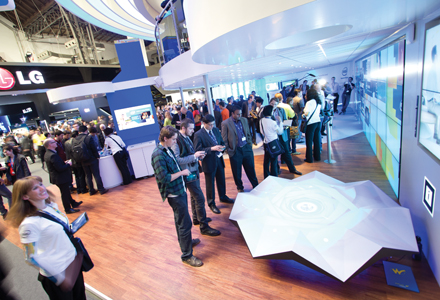
The 40-foot by 100-foot booth featured three key experience zones created to connect with original equipment manufacturers like Motorola, Nokia and LG, service providers like AT&T and Verizon, as well as developers and press. The three zones included “What’s in Your Pocket?” where participants shared their thoughts and photos by downloading an app and then answering multiple-choice questions. The survey results were presented on a large media wall, which had tablets in front of it allowing attendees to interact with the wall, along with pictures and other content. At the “User-controlled Projection Mapping” zone, attendees were encouraged to transform a blank, multi-dimensional sculpture into a dynamic art piece to reinforce how mobile devices will change in the years to come thanks to Intel technology. This area featured projection-mapping sequences by Brazilian artist SuperUber and Intel captured attendees’ emails to send them a picture of their sculpture. The “Mobile Mix” experience paid homage to the power of group creation with a professional “table jockey” who worked with attendees to perform mobile music mixes on a customized ReacTable. Objects on the table based on Intel solutions triggered electronic music tracks and audio sequences. The table jockey performed every half hour for five minutes and then attendees were invited to create their own mobile mixes. The interactions were captured on an overhead camera and displayed on a media wall.
There weren’t any traditional demo pods or product displays at this year’s booth, either. Instead, there were Digital Demos, which took the place of demo stations. Each segment had a flash-based presentation by an Intel expert using a pre-loaded tablet, making it all seem very Apple Store-esque. And, there was an Interactive Glass Showcase that highlighted new Intel-based mobile devices inside illuminated cubbies. When attendees placed their hands inside the cubbies, it triggered dramatic lighting and short audio sequences about the product on the glass wall (Live Marketing, Chicago, handled).
Intel also ditched its conservative cocktail reception and instead hosted a slammin’ party featuring the hit dj band LMFAO, which popularized the song “I’m Sexy and I know it.”
If none of this sounds like a b-to-b event, that’s the point. “We wanted to shock people a little bit and make them do a double take. We wanted to do some things that people didn’t expect from us,” says Marc Wallis, events program manager at Intel. The company also announced its soon-to-be launched phone in partnership with European service provider Orange at the show. “We’re still leaders in infrastructure, but we also have a great end-to-end story to tell. We built this whole booth to tell that story, and to surprise attendees was number one.”
Though a more consumer-style event experience was a hit, there are some things it can’t replace for tech industry buyers, says Wallis. “For this audience, we might have to bring back more technical and product information, whether through product demos, or even stage presentations, or expert bars. But at the same time, really well-crafted experiences can have a role with this audience also.” EM
EM's online directories offer direct access to the event industry's most trusted vendors, suppliers, venues and more.
The Germans bring the coolest exhibit the Olympic Park visitors almost missed.
The fan fave at this year’s Olympics, and we give you a look
Two floors of demos, data-collect and Acer Man
The first time Olympic sponsor blows it out of the Park--literally
Connect with Event Marketer